A column by local historian Lisa Ellis
The question arose from a general enquiry as to the finger on which a wedding ring is to be placed if a lady had lost the fourth finger of her left hand.
This wasn’t a question asked of me, and I admit I hadn’t really given it any thought. But this news article from 1825 did catch my eye as I was perusing it to find answers to a question asked of me about their own Melksham family member.
The answer is apparently the little finger. But why did the fourth finger gain its importance in the tradition in the first place? The newspaper responded, “…there exists, or was formerly supposed to exist, some nerve or connecting leader by which the heart is brought into union with the hand and that particular finger.”
The newspaper queried back as to what would happen if a lady had lost her left hand altogether. Or, in the case of Sarah Biffen, never having had any fingers at all.
The last line is what had my attention. Who was Sarah Biffin and why was she so well known as to being infamous for not having any fingers? Was she a relative of William Biffin, a former chief fitter for Melksham foundry, Messrs Spencer & Gillett? What horrific accident had she been in?
If a female from 1825 has her own Wikipedia page, you know that she is of some renown. And my introduction to Miss Biffen (1784-1850) had me in awe of her achievements. Born in East Quantoxhead, Somerset with phocomelia, she had no arms and only a trace of non-functional legs, and only stood at 94cm in adulthood. Around the age of 13, she apprenticed in a travelling show where she was exhibited at fairs and public events.
She’d taught herself to write and draw sketches using her mouth, and during Bartholomew Fair in London, her skill was spotted, and then later mentored to the point that a patron arranged for her to study under William Marshal Craig, a painter who studied at the Royal Academy.
Biffin was able to open a studio on the Strand in London, and during her career, she was commissioned by royalty. At 36, the Society of Arts awarded Biffin a medal for historical miniatures. She often signed her works “Without Hands”. A large collection of her work can be found in the Museum of Somerset in Taunton, and additional works are in the National Portrait Gallery, London. Biffin had been briefly married, and for a while, had exhibited under her married name “Mrs E M Wright”.
The question remains: Was Melksham’s William Biffin related to Sarah?
I confess I’ve spent way too long researching and building family trees in the hope that I could connect the two, but I fear my want has been overriding my logic. Besides, the surname “Biffin” has gone through a number of spelling iterations including Beafen, Boffin, Bevan, Beaven, Biffen, etc. The question has no end yet, but I will have to accept my disappointment that it’s probably “no”.
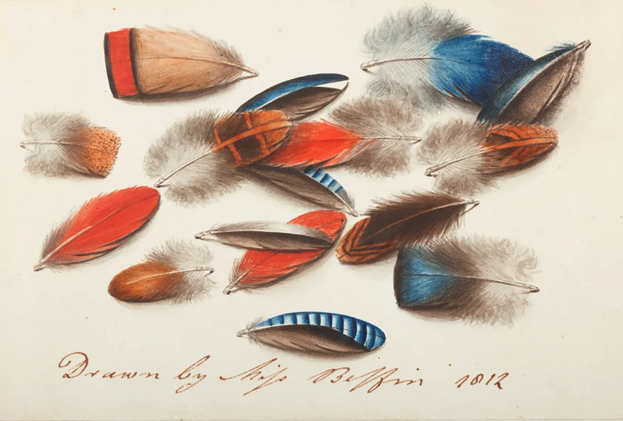
Pictured: A Study of Feathers by Sarah Biffen (1812) watercolour on paper
Support Melksham News
Help us keep your community connected and informed.
Local news is under pressure more than ever. Choose a monthly subscription or a one-off donation to support independent reporting in Melksham.
Send us your news!
Help us keep your community connected and informed.
Do you have an interesting story you would like to share? Have you seen something you feel needs more attention? Get in touch with a reporter today!
✉️ Click here to get in touch with a reporter