Melksham Times Past: Women’s rights in the Independent Church
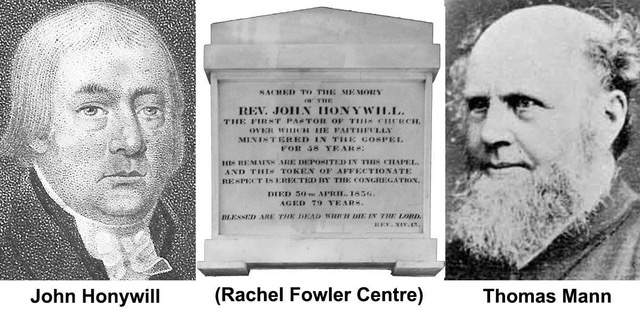
A Wiltshire Times article published on 9th November 1878 describes a speech given during the 100-year services of the Independent Chapel and to celebrate their renovations. One speaker, Rev T Mann, minister in Trowbridge, talked about the chapel’s origins when he related how Rev Honywill came to Melksham and how he’d gone on to remain as the minister for almost 60 years. (Honywill and his family lived on King Street in "Legion House".)
Quoting the article in bits: "The originator of the Independent Church whose centenary we celebrate to-day was John Honywill, its first paster…He was a man of 21 years of age when he settled here…and died at the ripe age of 79, respected by all, leaving behind him a blameless life, a holy example, and an attached and flourishing church…At the time of his settlement here he was a student in the Countess of Huntingdon’s College of Trevecca, now of Cheshunt. It was never her ladyship’s will that her students should be idle, so they went out on preaching excursions, and thus Mr Honywill came about these parts. In Melksham, there were a few who wished him to settle here. He was so desired to settle in Frome, but the Melksham people prevailed with him and won his heart. He had not completed his college term, and the Countess furiously opposed his settlement, and … [i]f he were resolved to settle in Melksham, she was resolved that her connection with him should cease, and that pony, gown, and bands those be provided at the expense of the people of Melksham."
The above gives a somewhat interesting anecdote of Mr Honywill’s arrival. But the speaker conjectured about how the Countess’s reactions and Honywill’s actions might have caused some rules to be adopted for the government of the church in 1795. Apparently women were to be kept in due subjection, and were plainly shown what their place was to be in the church meetings.
• Rule V. Witnesseth that every male member shall be fully at liberty to make any motion he may think proper, or to speak his mind on any subject that may be proposed.
• Rule VI. Though female members may vote in the election of a minster and deacons, they shall have no voice in the election of other officers of the church, in the elections or expulsion of members, or anything relating to church government; but they may relate or attest facts provided it be found expedient.
Then Rev Mann gave his own political view (bear in mind the centenary was around the time of women in general were rising up for their right to vote). "It is almost refreshing to us in these times of women’s rights advocacy to read such a deliverance as that."
He then went on to explain that one of Mr Honeywill’s successors "took it upon himself to kick over the traces, and at one sweep cleared the deck of all the rules." It almost seems as though Rev Mann lamented the loss of rules, but conceded that after the rules were abolished, "they (women) have not troubled the peace of the church or assisted its order for a good many years past."
Rev Mann’s remarks may have also been a remembrance that 33 years earlier, and nine years following Rev Honywill’s death, exclusions from communion were noted: Jeremiah Adams, James Knapp, Richard Mitchell and Michael Missom decided to remove Honywill’s daughter, Ann, and her cousin, Sarah Wilshere "whose uniform representation is that of discontent and dissatisfaction". Both women were unmarried. Ann died in 1865. Sarah (whose father was John Wilshire, a member of the Independent Church at Melksham for 43 years and a deacon for 30) died in 1858.
NB: Another independent woman, Rachel Fowler, acquired the church land and that of the Old Post Office, renovated the church (as mentioned in the above 1878 article) and in 1877 added the "Peoples’ Hall" in front to use as a library and non-denominational meeting room for the working man. In gratitude for her generosity, and with her permission, the townspeople procured an oil painting of the philanthropist. Originally meant to hang over the platform of the New Hall, this portrait can now be seen in the Rachel Fowler Centre, the former site of the Independent Church. Rachel Fowler died in 1882. Even after she built the almshouses and gave them and the above properties to the town, as well as to other charities during her lifetime, the value of her personal estate was more than £57,000.
Support Melksham News
Help us keep your community connected and informed.
Local news is under pressure more than ever. Choose a monthly subscription or a one-off donation to support independent reporting in Melksham.
Send us your news!
Help us keep your community connected and informed.
Do you have an interesting story you would like to share? Have you seen something you feel needs more attention? Get in touch with a reporter today!
✉️ Click here to get in touch with a reporter