A column about days gone by in Melksham by local historian Lisa Ellis
The Mystery of Spero Lodge
What does Masonic Lodge No 6825 in Essex have to do with Melksham Hospital on Spa Road
The first was consecrated on 20th April 1949; the latter was declared open by the Marquess of Bath on 27th July 1938. Is this clue any help with the answer? No?
How about the name “Spero”, which in Latin means “I Hope”. Got the reference now?
Even if I help you with an answer, you’re still not going to get it.
They are both contained in Spero Lodge. Actually, that’s not quite true. The answer, unless someone very clever does know, is that I can find no relation except for the name “Spero” and even then, dear readers, you are probably still scratching your head.
Spero aliquem mihi dicere posse.
Translation: “I hope someone can tell me.”
The earliest mention of someone living in Melksham’s Spero Lodge that I can find is in the 1861 census and even then it’s not directly titled “Spero Lodge” until you read an 1875 Wiltshire Times article that mentions the widowed occupant whose servant was helpful in getting a former Methodist preacher from Hilperton arrested for vagrancy.
Elizabeth (Tyler) Barling, a Quaker from Kent, was widowed at the age of 23 when her husband, Peter, a 27-year-old Kensington chemist and druggist, died two weeks before Christmas in 1830.
They’d been married only two years. Considering his business was located on Kensington High Street, and he left her with a pension and dividends that allowed her independence until her death at the age of 68, it’s no wonder she could afford to live in a substantial home on sprawling grounds.
How or why she moved to Melksham in the 1850s with no apparent family ties isn’t defined but may have to do with the strong Quaker influence here at the time.
I don’t know when Spero Lodge was built on the grounds we now view as Melksham Hospital but when the site was listed for auction in 1881, the home was described as being a substantially built dwelling house with garden.
Even though Elizabeth Barling had lived there before her death at the end of 1875, the property was owned by W H Long and the auction was not part of her estate. The Long family owned vast properties in the area and when Ellen (Thresher) Wrey (of the Long family) died, her portfolio was divided between two Long family factions. One side went to Rood Ashton and the other to Melksham. The Melksham side went bankrupt and this resulted in a mass property-holding meltdown.
James Usher had been renting Spero Lodge; he was a timber merchant who had a concession of coach building with Hurn Brothers and became quite a successful businessman with several employees at Steam Saw Mills at Melksham Railway Station since 1872. He eventually became owner of the property, but it’s not clear if it was at the 1881 auction.
Usher was well liked and regarded in town, was a town councillor for several years and served on the Board of Guardians; among many charitable acts, he opened a Blanket Fund. He married Jane Stockwell in 1860; they had no children.
Possibly commissioned by Usher, Alexander Gough Smith erected new buildings at Spero Lodge in 1896 – the buildings that posters on Facebook lament their emptiness-turned-dereliction.
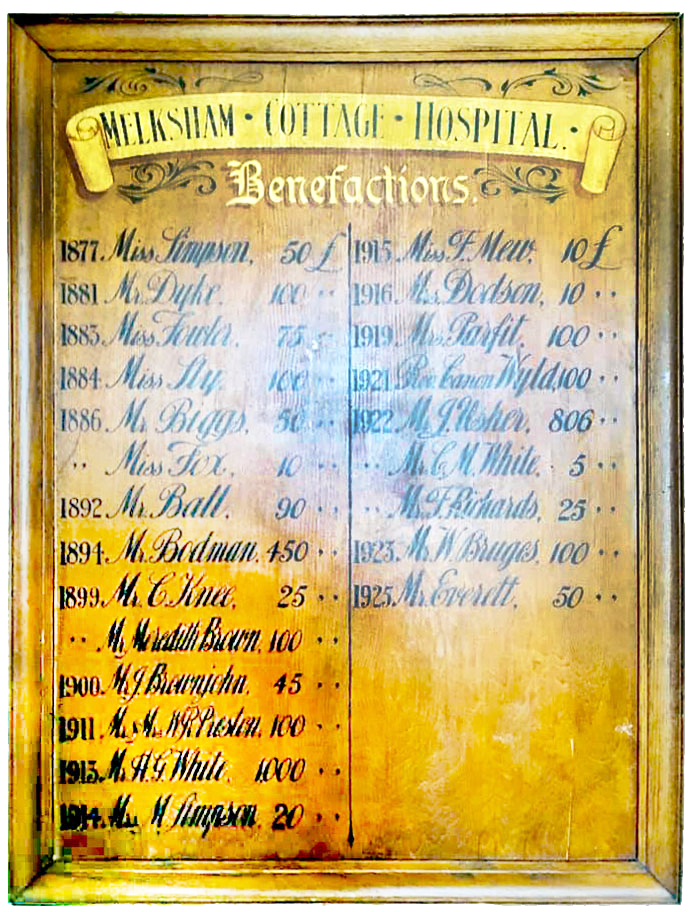
Upon his death in 1917 and the death of his sister-in-law ten months later, the buildings were left to the Melksham Cottage Hospital; the estates of both settled in 1922.
It is perhaps the location of these buildings that helped to decide the site of the Melksham Hospital we know today, and was purchased and then opened on 27th July, 1938, using the funds from a generous bequest of Mrs Ludlow-Bruges.
The two semi-detached villas at the entrance appear to have remained vacant for almost 20 years before the new hospital opened. They were then put in use for the male attendants and their families. The brick and tiled buildings beyond contained a chapel, post-mortem room with pathological laboratories and a mortuary.
Although it didn’t close entirely, Melksham Hospital stopped taking inpatients in November 2007, and it appears the two villas have also been closed for these past 20 years as well, all boarded up and going derelict.
Spero aliquid ex eis futurum esse.
Translation: “I hope something will become of them.”
Pictured: List of Benefactors to Melksham Cottage Hospital, note “1922 Mr J Usher 806 £”
Support Melksham News
Help us keep your community connected and informed.
Local news is under pressure more than ever. Choose a monthly subscription or a one-off donation to support independent reporting in Melksham.
Send us your news!
Help us keep your community connected and informed.
Do you have an interesting story you would like to share? Have you seen something you feel needs more attention? Get in touch with a reporter today!
✉️ Click here to get in touch with a reporter