A column about days gone by in Melksham by local historian Lisa Ellis
The Melksham House Memorial That Wasn’t
A public meeting was held in the New Hall in May 1919 to discuss a suitable memorial to the Melksham men who had fallen in World War I.
Several suggestions were presented with the object of the gathering to give the ratepayers the committee’s recommendations with a view to the adoption of some scheme.
Mr Knee of the committee reported that after the war ended and Melksham House was decommissioned as a Red Cross Hospital, the property had just been privately acquired and was being made available to the town. Chairman of the Avon Rubber Company, Major Fuller, approved the purchase of Melksham House and grounds, intimating that it would be a suitable memorial of the heroic sacrifice of the fallen as well as an expression of gratitude for those whose lives had been spared and to celebrate the termination of the war. An offer was made to the town, which Mr G W Harding explained in detail:
“The property,” he said, “could be acquired for £5,300, which would include legal and other expenses.” He then read a description of Melksham House, in which amongst other things it was stated that it contains, “on the first floor nine good bedrooms, in addition to other rooms; there is stabling, a large garden, and two cottages”. He continued, “The total area of land including that round the house with Conigre Farm and the field adjoining is 27a 25p.”
It was suggested that if the property was purchased by the town, a monument might be erected in any part of the grounds and the committee were quite willing that such part should be handed over and that Canon Wyld could have charge of it for his memorial scheme. Mr Harding then mentioned a number of uses – they might have a gymnasium (there were three rooms in the house which could easily be converted into one and make an excellent room for entertainments, etc). They might have a library, council offices and other things there. Proceeding to deal with the grounds, Mr Harding pointed out that the grounds might be laid out for tennis, croquet, and other games.
Another advantage was that a road might be made through to King Street and the land would form the best building site in the town.
Harding concluded that he thought it would be of great value in the near future and assured the audience that there was an opportunity of securing a very valuable property at a low price, and strongly recommended to them to avail themselves of that opportunity for the benefit of the town.
Canon Wyld had objections. He was representing 90 percent of the near relatives of those who had fallen and they all agreed the memorial should be separate and distinct. A beautiful design had been drawn out by a London artist and he felt there could be no more suitable site chosen than the one selected, opposite his residence, the vicarage. There was to be a handsome cross with five steps leading up to it and the names of those who had fallen, recorded in a way which would be practically everlasting. Canon Wyld did not object to a Melksham House scheme; he just did not want it mixed up with the memorial he wanted to see erected and already had funding for.
While the majority of the committee was in favour of having the war memorial on the grounds of Melksham House, ratepayers were not sold on the idea of acquiring Melksham House for the town’s use. Subsequent meetings did not persuade them, and Melksham House was then put into private use by the employees of Avon Rubber for recreational purposes.
Avon then got to work in completely renovating the interior of Melksham House for its own use. Soon after it opened, a major fire broke out in December 1920 and a large portion of the house was destroyed, the damage reached into the thousands of pounds.
In the summer of 1932, Avon Sports and Social Club opened a new swimming pool in the river at the rear of Melksham House; a virtual lido – open seven days a week, a properly organised swimming club where regulation costumes had to be worn and changing huts used (taking the place of youngsters flopping into the water more often than not without costumes or changing behind the nearest bramble-bush, if any).
Still needing some sort of recreation space for the people of Melksham, the council appealed to Avon Sports Club in February 1935. The suggestion was made that perhaps some arrangement could be arrived at with the owners whereby the townspeople of Melksham could share in the amenities of the grounds at Melksham House. It was felt that this, if it could be done, would be a good means of providing the town with park facilities. The Social Club committee, made up of Avon employees, later returned a verdict – no.
Another suggestion to acquire Melksham House and its grounds came to the Melksham Urban District Council in January 1955 as part of their Development Plan. J H Marti appealed to the committee to consider the central location of Melksham House instead of the drastic plans of demolishing several historic homes in the Church Walk area for commercial and residential growth.
He wrote, “On very good authority I understand it is only used by about ten per cent of the Avon Employees, so I think very little grief would be shown at its acquisition.” He continued, “By using this site no one would be deprived of home or house, and it would be on high, dry land. Also, there would be no destruction of historical gems, as although Melksham House itself is old, it was restored after a big fire many years ago.”
Marti’s plans included: car parks and a swimming pool at the existing Lady’s Pond.
In 2011, Wiltshire Council acquired Melksham House from Cooper Tire and Rubber Company, formerly Avon, with the promise of an all-encompassing campus.
The outcome?
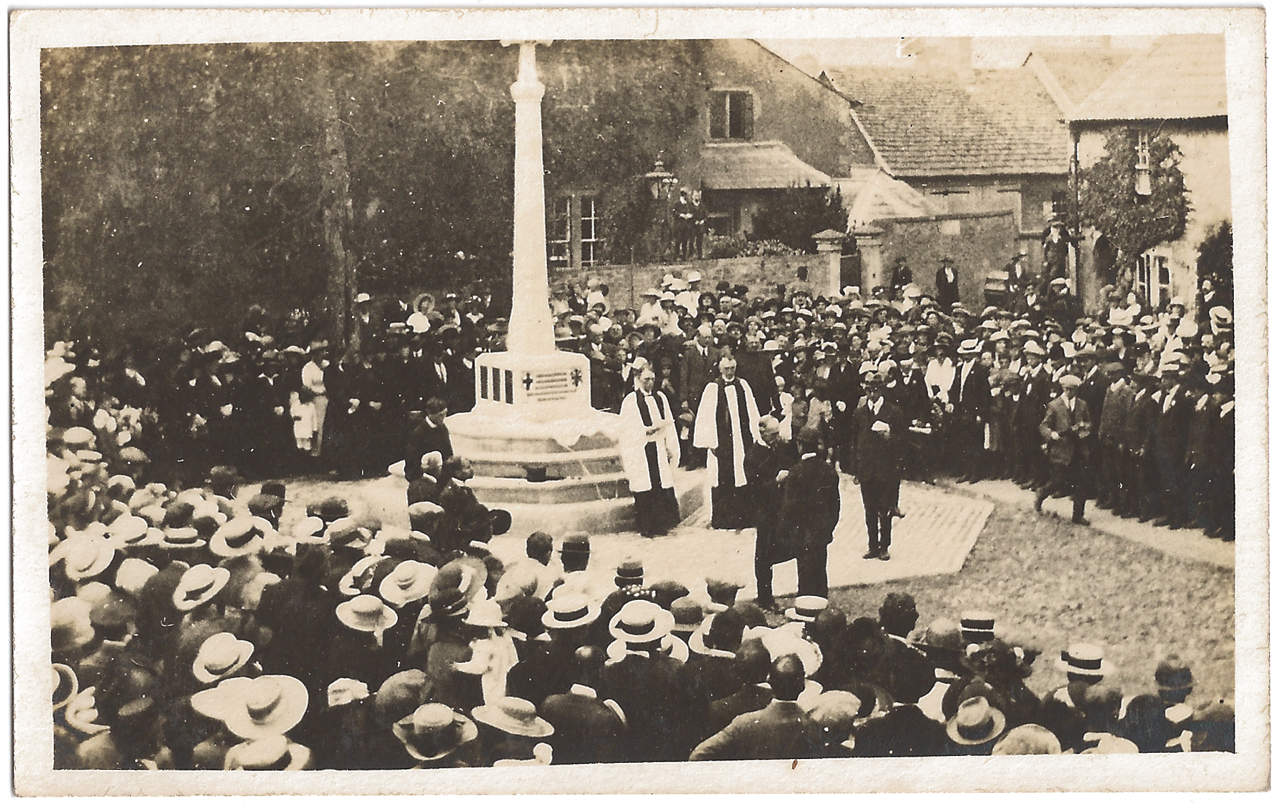
Rev Wyld’s proposal was favoured and completed to plan in six months, and was dedicated on 23 August 1919.
The Melksham Community Campus opened 103 years later on 1 August 2022 without the inclusion of Melksham House, which was renovated and transformed into a specialist SEND school, and officially opened in September 2025.
Pictured: Dedication of the War Memorial on Church Walk in 1919.
Support Local News
Help us keep your community connected and informed.
Local news is under pressure more than ever. For just £2 a month, you can support independent reporting that shares local stories, investigates the issues that affect you, and keeps residents up to date.
Choose a monthly subscription or a one-off donation. All donations will be reinvested into producing local journalism for Melksham.
Donate Now