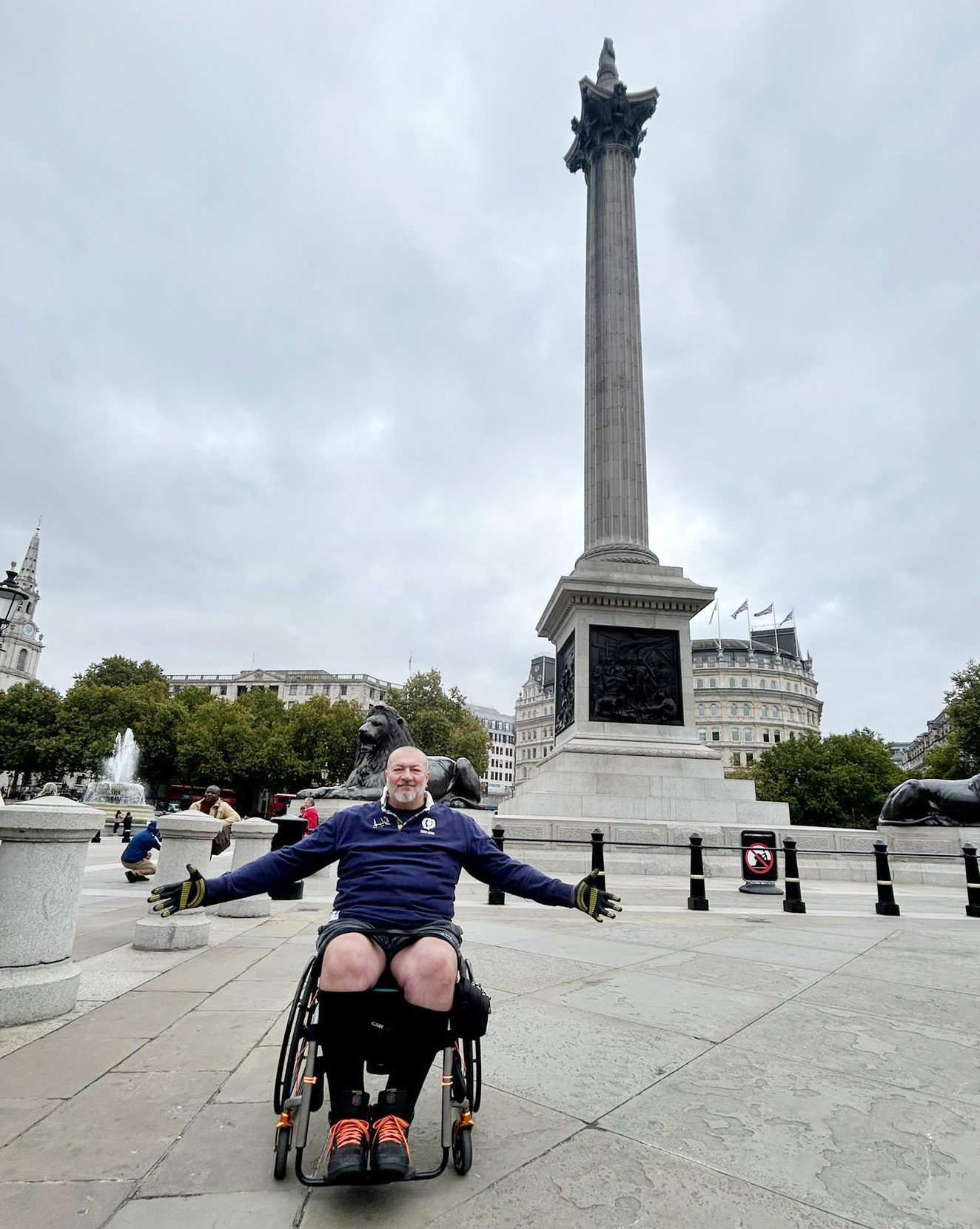
A Melksham resident with a spinal cord injury has been part of a challenge to test the accessibility of public transport.
Chris Davis, who uses a wheelchair, was one of six people with spinal cord injuries from across the UK challenged to plan and complete a journey to central London within 48 hours, using at least two forms of public transport, including trains, buses or the tube.
Each participant was required to map their own route, navigate unexpected barriers and document their experience using video diaries and a detailed scorecard to assess accessibility at every stage.
The challenge was organised by the Spinal Injuries Association, of which Chris is a volunteer. He said, “Our message is that accessible travel can be challenging but it shouldn’t put you off from trying.”
Despite careful planning, Chris encountered repeated barriers and ultimately, completed the challenge as intended by using two forms of public transport – train and bus. Using the campaign’s scorecard system, Chris rated his journey highly in many areas booking 9/10, staff assistance 9/10, and London buses 9/10. However, this masked a critical failure, taxi accessibility, which he scored just 2/10, and could have resulted in him missing his train.
He said, “Before a journey I try and think of as many things that can go wrong as possible and find solutions for it. Then when I go, I know I have done all that I can.”
Chris encountered his first issue in Melksham. He said, “I couldn’t actually get the bus service to work because it was either at 6.30am or too late for the first train out, so I had to get my wife to drive me to the station in Chippenham. That was a failure in a way, there wasn’t enough of a service to be able to do it.”
Upon reaching the train platform, Chris was disappointed to discover that the accessible carriage was positioned at the very end of the train, meaning he had the furthest distance to travel along the platform.
On the return journey, Chris faced further disappointment when he attempted to use a taxi. He said the ramp was not large enough to accommodate his wheelchair, meaning he was unable to use his preferred mode of transport.
He said, “Better taxi access would make the biggest difference. I would recommend the route to other wheelchair users, but you still have to plan everything in advance, which shouldn’t be the case for public transport.”
Chris said part of the problem is the old infrastructure in the UK. “If you look at new buildings, like the Campus, they have fantastic facilities for people with disabilities and access needs. There are two lifts, accessible parking spaces, everything has been thought about. This is a new building though.”
Support Melksham News
Help us keep your community connected and informed.
Local news is under pressure more than ever. Choose a monthly subscription or a one-off donation to support independent reporting in Melksham.
Send us your news!
Help us keep your community connected and informed.
Do you have an interesting story you would like to share? Have you seen something you feel needs more attention? Get in touch with a reporter today!
✉️ Click here to get in touch with a reporter