A column about days gone by in Melksham by local historian Lisa Ellis
Weighing in on bread laws
In 2008, The Telegraph announced that bread rules were being abandoned after 750 years. “A slice of history was created when the first ever 600g loaf went on sale, ending centuries-old legislation that has governed the weight of bread.”
In 1266 the Assize of Bread and Ale dictated that no baker in England would be allowed to bake a loaf unless it conformed to a certain weight. Since then, similar strict laws followed and is why sliced bread was sold in the standard 800g, or the half-sized 400g loaves.
What changed? A European directive abolished more than 800 years of British history and allowed bakers to bake loaves of any size, which, in turn, allowed boulangeries to open in this country. And this is why you can buy croissants made in a Tesco bakery.
Before then, the former legislation was strictly upheld by Trading Standards, whose officers often made spot checks at bakeries.
After the death of her husband in 1859, Jane Watson continued her bakery business in the Market Place. At the time, the role to verify the weights during these bakery spot-checks was undertaken by Supt. Wolf of Devizes, inspector of weight and measures.
On 15th September, 1866, Mr. Wolf was passing through Seend when he saw a number of poor people waiting to receive their weekly supply of bread.
Amongst the people queuing for the bread was Relieving Officer, Singer Stokes, who was purchasing bread for the Board of Guardians. The loaves were handed to Mr. Stokes, who then put them in his cart, to later be given out to paupers. In the course of his duty, Mr. Wolfe weighed each of the 32 four-pound loaves and found that all but two were underweight, varying from one and a half to two ounces.
The case of the underweight bread was brought before the court, with Ambrose Awdry as chairman.
The Devizes and Wiltshire Gazette summarised the outcome as Mr. Awdry making a good point.
“The Chairman (Mr. Awdry) said he was sure the public would thank Mr. Wolfe for bringing the case before them, as it was a most proper one to expose; but he must confess he saw some technical difficulty in the way: namely, that the Relieving Officer having ordered a certain quantity of bread from the defendant, as contractor under the Board of Guardians, and the bread having been placed in the cart by Mr Stokes’ directions, it must after that be considered as in his possession; and although conveyed to Seend in Mrs. Watson’s cart and by Mrs. Watson’s man, still Mr. Stokes, the relieving officer, must be considered as delivering the bread and not the defendant’s servant. The case must therefore be dismissed.”
Note: Concerning straight versus curved croissants, Tesco has been selling only the straight ones since 2016. Contrary to rumour, this wasn’t because of Brexit but rather the result of a survey that indicated 75% of their customers preferred their croissant straight because it was easier to apply their choice of spread. I still need to get to the bottom of a French law that only allows the sale of straight croissants if they are made with butter. Also, by law in France, a true boulangerie must mix, shape and bake bread on-site.
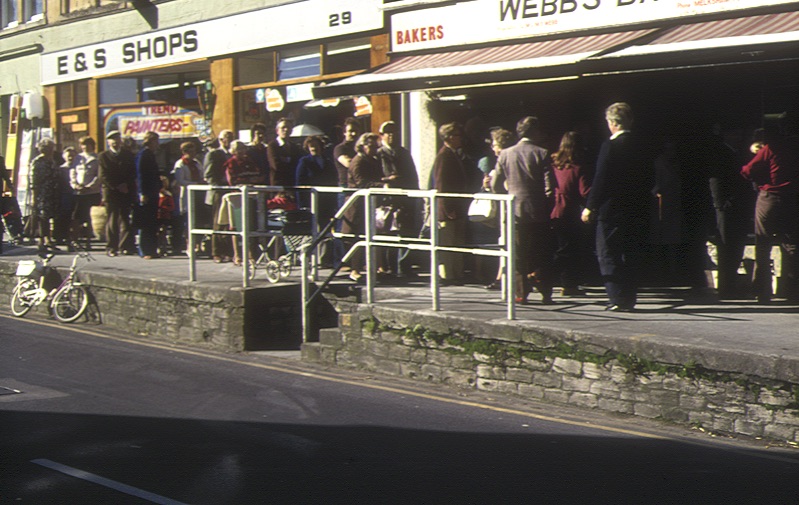
In September 1977, baking workers took industrial action over pay, which created a severe shortage and long queues at bakeries, such as this one at Webbs on Bank Street.
Shops implemented rationing to cope.
Pictured: Queues at Webbs on Bank Street due to industrial action. Picture credit: A P Seager, ARPS
Support Local News
Help us keep your community connected and informed.
Local news is under pressure more than ever. For just £2 a month, you can support independent reporting that shares local stories, investigates the issues that affect you, and keeps residents up to date.
Choose a monthly subscription or a one-off donation. All donations will be reinvested into producing local journalism for Melksham.
Donate Now